SEO Process Steps: A Practical Guide to Improving Search Visibility
Search engine optimisation (SEO) is the process of improving a website so that it can be found more easily in organic search results. It combines research, technical improvements, useful content and ongoing analysis. SEO is not a one-off task: it works best as a continuous process shaped by your audience, your goals and changes in search behaviour.
Here are the main steps involved in a practical SEO process.
Set clear goals
Start by deciding what SEO should achieve for your business. Goals might include attracting more relevant visitors, increasing enquiries, growing online sales or improving visibility in a particular area.
Choose measurable indicators that relate to those goals. These could include organic visits to important pages, qualified leads, online sales, search visibility or conversions. Rankings can be useful to monitor, but they are only one part of the picture.
Understand your audience and market
Effective SEO begins with understanding the people you want to reach. Consider what they need, the questions they ask and the language they use when searching. Review your products or services, your competitors and the search results for topics that matter to your business.
This research helps reveal the types of pages people expect to find, whether they are looking for information, comparing options or ready to take action.
Carry out keyword research
Keyword research identifies the search terms and topics that are relevant to your audience. Look beyond individual phrases to understand the intent behind them. For example, someone searching for advice may need an informative guide, while someone comparing providers may be looking for a service or comparison page.
Group related searches into themes and match each theme to the most appropriate page. Avoid trying to make one page target every possible keyword; a clear focus usually makes the content more useful.
Audit your website
An SEO audit gives you a picture of how your website is performing and highlights issues that could limit its visibility. Review areas such as:
- Pages that are missing, duplicated or difficult to find
- Broken links and redirect problems
- Page titles, headings and meta descriptions
- Mobile usability and page speed
- Indexing and crawlability
- Internal links and site structure
- Existing content that is outdated or underperforming
Prioritise problems according to their likely impact and the effort needed to fix them. Technical findings should be checked carefully before making changes, particularly on larger websites.
Improve technical SEO
Technical SEO helps search engines discover, crawl and understand your website. It also supports a positive experience for visitors. Make sure important pages can be accessed by search engines and that the site works well on mobile devices.
Depending on your website, technical improvements may include fixing broken links, creating a logical URL structure, improving page speed, using redirects correctly and providing an XML sitemap. Structured data can also help search engines interpret certain types of content, where appropriate.
Optimise your pages
On-page SEO is the process of making individual pages clear and relevant for both people and search engines. Give each important page a distinct purpose and make sure its content addresses the needs behind the relevant searches.
Review the page title, main heading, subheadings, URL, images and internal links. Use descriptive wording naturally, rather than repeating keywords unnaturally. A clear meta description can also help searchers understand what a page offers, although search engines may choose to display different text in results.
Create useful, high-quality content
Content should answer real questions and provide information that is accurate, clear and useful. Depending on your audience, this could include service pages, product descriptions, guides, FAQs, case studies or local landing pages.
Before creating a new page, check whether an existing page already serves the same purpose. When updating content, improve its accuracy and usefulness rather than making changes solely to add more keywords. Make sure important claims are supported and that the page is easy to read.
Strengthen internal linking
Internal links connect pages on your website. They help visitors find related information and can help search engines understand how your content is organised. Link between relevant pages using concise, descriptive link text.
Important pages should be reachable through sensible navigation and links from other relevant parts of the site. Avoid adding links where they do not help the reader.
Build authority and trust
Off-page SEO includes actions that help build your website’s reputation beyond its own pages. Relevant links from reputable websites can help people discover your content and may contribute to how search engines assess your site.
Focus on earning attention through worthwhile resources, strong services, original research and genuine relationships. Avoid buying links or using schemes designed to manipulate rankings, as these can put your website at risk.
Measure results
Use analytics and search performance tools to understand what is happening after changes are made. Track organic traffic, conversions, visibility, engagement and the performance of priority pages. Compare results over time and take seasonality or other marketing activity into account.
Allow enough time for changes to be crawled and assessed. SEO results rarely appear instantly, and performance can fluctuate for many reasons.
Refine and repeat
SEO is an ongoing cycle. Use your results to identify what is working, what needs attention and where new opportunities have emerged. You might update an existing guide, improve a page with low engagement, fix a technical issue or create content around a newly important topic.
Review your priorities regularly, but avoid making frequent changes based on short-term fluctuations alone. Consistent, evidence-led improvements are more useful than reacting to every movement in rankings.
How long does the SEO process take?
The time needed to see results depends on factors such as your website’s current condition, the competitiveness of your market, the resources available and the scale of the work. Some technical fixes may have a relatively quick effect, while building visibility for competitive topics can take considerably longer. Regular monitoring helps set realistic expectations and guide future work.
Conclusion
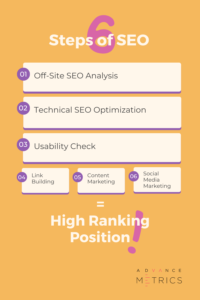
A sound SEO process starts with clear goals and audience research, then moves through technical improvements, page optimisation, useful content and ongoing measurement. By following these steps consistently, businesses can make their websites easier to find, more helpful to visitors and better aligned with their objectives.
Essential SEO Steps: From Site Audit to Strategy Refinement
- Audit your site and identify technical issues.
- Research relevant keywords and search intent.
- Optimise pages with clear titles and useful content.
- Build quality links and strengthen internal linking.
- Track rankings and traffic, then refine your strategy.
Audit your site and identify technical issues.
Audit your website to uncover technical issues that could prevent search engines from crawling, indexing or understanding your pages. Check for broken links, duplicate content, slow-loading pages, mobile usability problems, incorrect redirects and missing or blocked pages. Prioritise fixes by their potential impact on visibility and user experience, then review your site regularly to catch new issues early.
Research relevant keywords and search intent.
Researching relevant keywords and search intent helps you understand what your audience is looking for and why. Identify the words and phrases people use, then consider whether they want information, are comparing options or are ready to take action. Use these insights to create or improve pages that match their needs, rather than simply adding keywords for the sake of it. This makes your content more useful to visitors and gives search engines clearer signals about its purpose.
Optimise pages with clear titles and useful content.
Optimise each page with a clear, descriptive title that reflects its main topic and helps people understand what to expect. Pair it with useful, well-organised content that answers visitors’ questions and meets their needs. Use headings to make information easy to scan, and include relevant search terms naturally rather than repeating them unnecessarily. A helpful page is more likely to earn visitors’ trust and encourage them to take the next step.
Build quality links and strengthen internal linking.
Build quality links by creating useful, trustworthy content that relevant websites genuinely want to reference, and by developing relationships within your industry. Avoid buying links or using schemes designed to manipulate search rankings. At the same time, strengthen internal linking by connecting related pages with clear, descriptive link text. This helps visitors find useful information and gives search engines a better understanding of your site’s structure and which pages matter most.
Track rankings and traffic, then refine your strategy.
Track your search rankings and organic traffic regularly to see which pages and search terms are gaining visibility, and whether visitors are taking the actions you want. Use these insights to identify what is working and where improvements are needed. You might update a high-potential page, strengthen internal links or explore a topic your audience is searching for. Refine your strategy based on consistent trends rather than reacting to short-term fluctuations, and keep measuring the results of each change.